King & Snohomish County Rental Market Update: Summer 2026
A more balanced market — but property type and size matter
The Puget Sound rental market is showing a more nuanced pattern this summer. Rents have not fallen across the board, but renters have more choices in some segments, and the difference between smaller apartment-style rentals and larger homes is becoming increasingly important.
For rental property owners, the takeaway is straightforward: there is no single “Seattle rental market.” Pricing performance depends heavily on the type, size and location of the property.
King and Snohomish County rents remain relatively stable
Zillow's county-level Zillow Observed Rent Index (ZORI) shows modest year-over-year rent growth through June 2026:
- King County: $2,330 average rent, up 1.0% year over year
- Snohomish County: $2,232 average rent, up 1.6% year over year
ZORI is designed to measure changes in asking rents while controlling for changes in the mix and quality of available rental properties. In other words, it is useful for answering the question, “How are rents trending over time?”
But another Zillow measure gives us a different—and very useful—perspective.
Current asking rents tell a more mixed story
Zillow's current rental-listing data for Seattle show an average asking rent of $2,127 in July 2026, down $49—or about 2.3%—from July 2025. At the same time, rents increased $77 from June to July, showing the normal seasonal summer pickup.
This doesn't necessarily conflict with the modest growth shown by ZORI. The two measures answer different questions: ZORI adjusts for changes in the composition of available rentals, while Zillow's rental-listing data reflect what is currently being advertised.
For a property owner preparing to list a rental, current asking rents are particularly relevant because they represent the competition a prospective tenant is seeing today.
The biggest difference may be property size
The Seattle data become much more interesting when broken down by bedroom count.
According to Zillow's July rental data:
- Studio: $1,450 | -$25 YOY
- 1 bedroom $1,817 | -$58 YOY
- 2 bedroom $2,634 | -$61 YOY
- 3 bedroom $3,778 | +$188 YOY:
That is a meaningful distinction.
Smaller rentals are experiencing more pricing pressure, while three-bedroom rentals are holding up considerably better.
And when we narrow the data further to three-bedroom houses, the difference becomes even more pronounced. Zillow reports an average July rent of $4,080 for three-bedroom houses in Seattle, up $330—or roughly 8.8%—from a year earlier.
That doesn't mean every three-bedroom house is suddenly worth 9% more. Individual properties can perform very differently. But it does suggest that larger single-family rentals are operating in a very different competitive environment than smaller apartment rentals.
CoStar shows a similar pattern in the multifamily market
CoStar data compiled by Kidder Mathews also show a relatively stable Seattle multifamily market.
In Q2 2026, Seattle multifamily vacancy was 6.7%, down from 7.0% a year earlier. Average asking rent was $2,048, up 0.9% year over year. Importantly, renter demand continued to outpace new construction, with 6,085 units of net absorption year-to-date compared with 3,813 units delivered.
CoStar's Q2 data also show how dramatically rents vary by unit size:
- Studio: $1,544
- 1 bedroom: $1,908
- 2 bedroom: $2,285
- 3 bedroom: $2,631
The data don't establish that every larger multifamily unit is outperforming smaller ones, but they reinforce an important point: unit size and property type matter when evaluating rental performance.
Snohomish County continues to show relatively strong rental fundamentals
Snohomish County stands out in the multifamily data.
In Q1 2026, CoStar data showed Snohomish with a 6.1% multifamily vacancy rate, the lowest among the major Puget Sound submarkets, while average rent was $1,940. Kidder Mathews described the combination as evidence of solid demand even though rents had eased slightly.
Zillow's county-level data tell a similar story from a different perspective: Snohomish County's ZORI was up 1.6% year over year through June, compared with 1.0% in King County.
That doesn't mean every Snohomish rental is performing better than a comparable King County property. But the broader data suggest that Snohomish remains a relatively healthy rental market.
More Inventory Is Bringing the Housing Market Toward Balance
The rental market is also being influenced by what's happening in the for-sale market. Buyers have more choices than they did a year ago, as inventory has increased substantially across King and Snohomish counties.
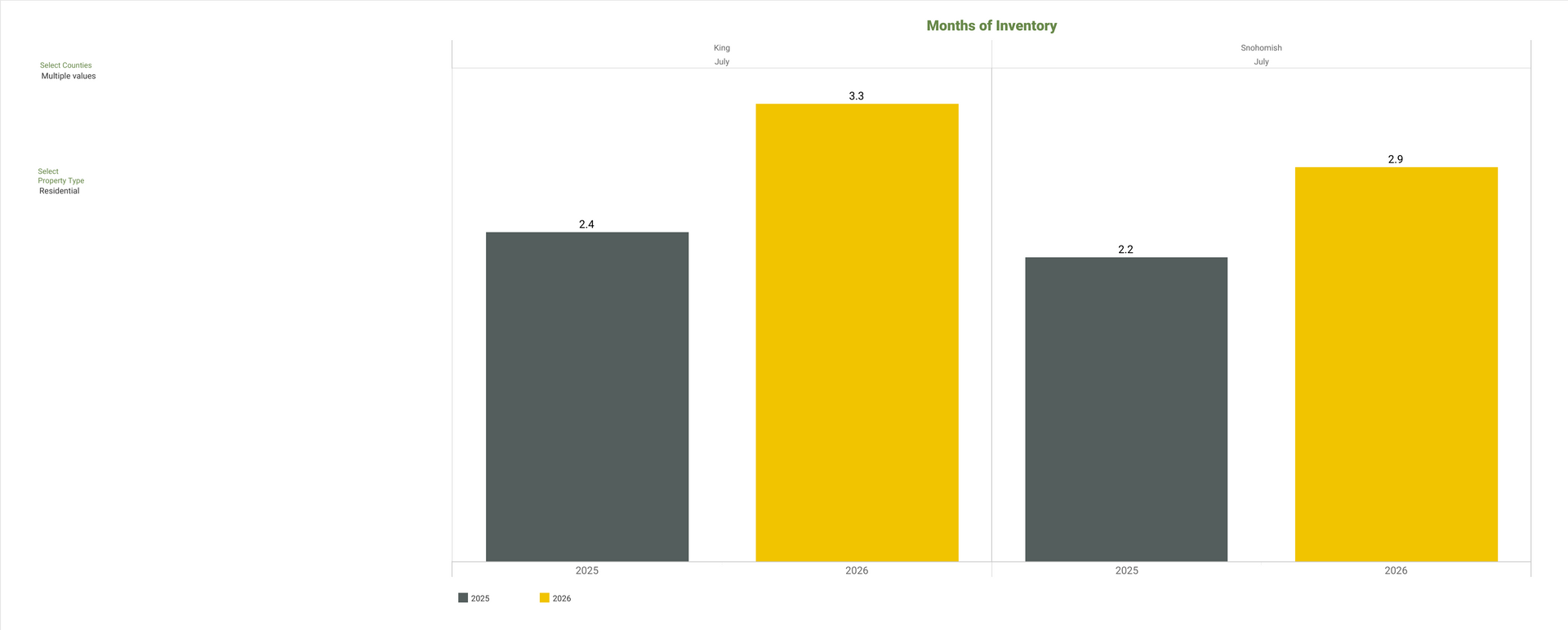
The latest NWMLS data show residential months of inventory increased from 2.4 to 3.3 months in King County and from 2.2 to 2.9 months in Snohomish County from July 2025 to July 2026.
The shift is even more pronounced for condos:
King County condos: 4.0 →
5.9 months
Snohomish County condos: 2.9 →
3.7 months
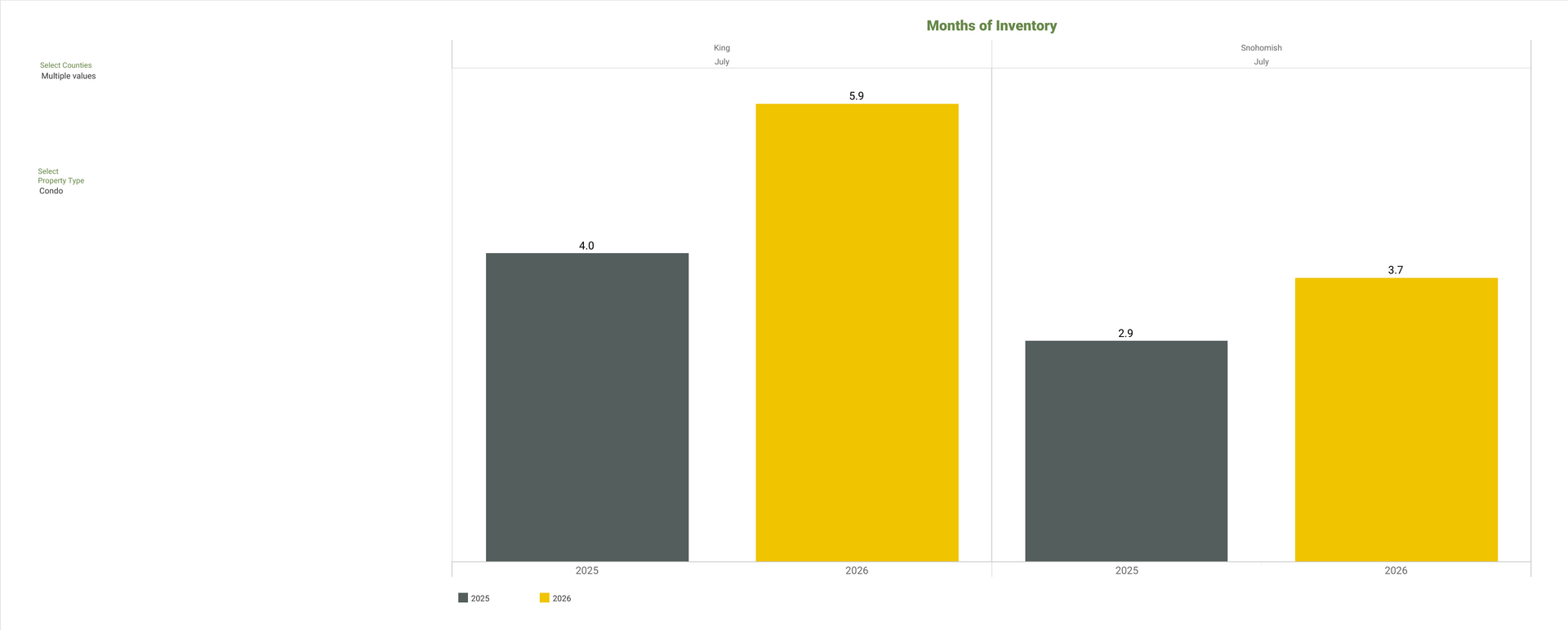
More inventory gives buyers more options and means sellers may need to be more strategic about pricing and positioning their properties.
Source: NWMLS, July 2026 data provided in the accompanying market update.
More inventory means buyers have more choices, particularly in the condo market. For owners who are considering selling an investment property, that may affect the timing of a sale—and for some owners, continuing to rent may remain the more attractive option.
What does this mean for rental property owners?
The summer 2026 market isn't a market where owners should panic about falling rents. But it is a market where owners need to pay attention to the details.
A one-bedroom condo in Seattle is competing in a very different market from a three-bedroom house in Shoreline, Bothell or Snohomish.
And the difference isn't just the monthly rent.
It's the number of competing properties, the type of renter looking for the property, the availability of new construction, and how much choice renters have.
For owners, that makes accurate pricing more important than simply looking at what a similar property rented for last year.
The bottom line
The 2026 rental market is becoming more balanced, but it isn't moving uniformly.
King and Snohomish County rents remain relatively stable overall, with modest year-over-year growth in Zillow's county-level rent index. At the same time, current Seattle asking rents are softer than a year ago.
The most notable difference is by property size: smaller rentals are seeing more pricing pressure, while larger three-bedroom homes have been considerably more resilient.
For rental owners, the lesson is simple:
Don't price your property based on the regional average—or last year's rent. Price it based on today's competition for your specific property.
Sources & methodology
Zillow Rental Market Trends and Zillow Observed Rent Index (ZORI), data available through June/July 2026; CoStar data compiled by Kidder Mathews, Q2 2026; NWMLS July 2026 housing inventory data.
Zillow's ZORI and current rental-listing data use different methodologies and should not be treated as directly comparable. CoStar/Kidder Mathews data primarily represent multifamily properties, while Zillow's rental data include multiple property types. Accordingly, the figures above are used to identify
directional trends rather than as interchangeable measures of rent.